
The Careful Sword
A Benjamin Tallmadge Story
Prologue
Washington had a problem, and it was getting worse.
February 1778. Eighteen months commanding the Continental Army. Eighteen months of making decisions in the dark while the British moved with the confidence of men who actually knew what their enemy was doing.
He'd tried civilians. Nathaniel Sackett, an upstate New York merchant, was hired a year ago to build a spy network—result: nothing of substance. He'd tried military officers. Major John Clark in Philadelphia had shown real promise until a musket ball shattered his shoulder. Clark requested relief in December. Cannot run intelligence operations when you cannot use your arm.
He had General Charles Scott running traditional military intelligence. Bold agents on discrete missions. High casualty rate, inconsistent results, sometimes brilliant but often fatal.
What Washington needed, what he did not quite realize he had, was a twenty-four-year-old major who had spent two years watching all these approaches fail and taking very careful notes about why.
Major Benjamin Tallmadge coordinated couriers for Sackett's network. Verified reports for Clark's Philadelphia sources. Served as liaison between Washington's headquarters and whoever was currently trying to gather intelligence without getting hanged. Administrative work. The kind of job nobody notices until it stops getting done.
Tallmadge noticed everything, though—every failure, every near-miss, every agent who walked into enemy territory and never came back. He was learning lessons that would change how intelligence work was done.
Washington's problem was about to get worse. If Tallmadge was right about what he was learning, it might get better.
Four months after they hanged Nathan Hale, Tallmadge started a notebook.
January 1777. New Jersey. Winter quarters. The army was licking wounds from a year of defeats that were starting to feel inevitable. Most officers drank, some gambled, and a few read, but Tallmadge cataloged failures.
British intelligence appears systematic rather than opportunistic. Evidence: their foraging parties consistently strike productive farms while avoiding depleted ones. Conclusion: they maintain updated lists of resources, likely gathered through Loyalist informants with local knowledge.
Continental intelligence relies heavily on individual initiative. Evidence: success varies wildly between commanders, with no sharing of methods or information. Conclusion: We are reinventing solutions to identical problems.
Note on volunteer spies: High courage, low survival. See: Hale, N.
First time he'd written Nathan's name. The observation sat there like an accusation.
Tallmadge's hand paused over the page. They'd been roommates at Yale and argued about theology and politics late into the night. Nathan had believed so completely in the righteousness of their cause, in the power of individual courage to change the world. The ink was already dry. The observation is complete.
Clinical. True. Unbearable.
Nathan died in New York. Walked alone into territory he did not know, tried to be someone he was not, got caught, and got hanged—accomplished nothing except proving that courage without preparation was merely a faster way to die.
What if you sent someone who actually belonged there, though?
Long Island. Tallmadge's homeland. Setauket, where he grew up. People there had known him since he was a boy. They still knew his family. Lived under British occupation and probably resented it, if you knew which ones to ask. Someone from there would not be pretending. Would not need a cover story because their whole life was the cover story.
Just theory, though. For now, Tallmadge had actual work. Coordinating Washington's various intelligence operations and learning from their failures.
Turned out that was the most valuable education he could have gotten.
Chapter One
Nathaniel Sackett arrived at Washington's headquarters in February 1777 with enthusiasm, Patriot sympathies, and a commission to build a spy network on Long Island.
He was a civilian merchant with New York connections and actual experience in clandestine work. Washington needed intelligence from occupied territory badly enough to try unconventional approaches. Tallmadge got assigned to work with him to help establish the network, provide military coordination, and learn the work.
Tallmadge had never run intelligence operations before. Sackett had.
"The challenge," Sackett explained during their first planning session, "is recruiting reliable people who can gather information without arousing British suspicion. Then, train them properly."
"What does that training involve?" Tallmadge asked, pulling out his notebook.
"Disguises, first. Not theatrical but practical. How to alter your appearance enough that someone who knows you casually might not recognize you in a crowd. Communication protocols. Dead drops. How to conceal messages. How to verify you're not being followed." Sackett spoke with the confidence of someone who had done this before. "Codes for sensitive information. Cover stories that hold up under questioning. When to abort an operation if something feels wrong."
Over the following weeks, Tallmadge learned tradecraft he had never encountered in military service. How to create invisible ink from common household items. How to establish courier networks with cutouts so no single capture could expose the whole chain. How to assess potential agents for reliability, motivation, and operational security.
Sackett knew his business. That became clear quickly.
The problem was not Sackett's tradecraft. The problem was the territory.
They worked together through spring, attempting to build networks in New York and Long Island. Sackett recruited sources—people who claimed Patriot sympathies, who wanted to help the cause, who seemed reliable in initial meetings.
Tallmadge watched it not work.
"How well do you know this farmer you're recruiting?" Tallmadge asked after one meeting in May.
"Met him twice. Strong Patriot sympathies. Needs the money, which gives him motivation beyond ideology."
"But do you know his family? His business? His neighbors? Whether the British trust him or watch him?"
Sackett frowned. "I know his reputation. Other Patriots vouch for him."
"Other Patriots you also just met," Tallmadge said carefully. He was learning from Sackett, not critiquing him. Trying to understand the problem. "You're recruiting strangers based on recommendations from other strangers. In territory you don't know well."
"I know New York, Major. I've done business there for years."
"In the city. But these networks are on Long Island. Different communities. Different dynamics." Tallmadge had grown up in Setauket. He was beginning to see what Sackett could not. "When you recruit someone, can you verify their whole life? Their family connections? Whether the British have reason to trust them or suspect them?"
Sackett looked uncomfortable. "That level of verification would take months. We need intelligence now."
"Rushing gets people killed, sir. Or worse, gets them turned, feeding us false information."
It was the fundamental problem, and Tallmadge saw it more clearly each week. Sackett had the skills. Had the tradecraft. Knew how to run agents, establish protocols, and train sources. What he lacked was local knowledge. He was an outsider trying to build networks in communities he did not truly understand, recruiting people whose entire lives he could not verify.
Someone from Long Island, someone like Tallmadge, if he were running operations there, would know which farmers were reliable because they had grown up together. Would know which families the British trusted, which merchants traveled legitimately, and which tavern keepers could be approached safely.
Sackett was operating blind in places he thought he knew but did not.
By summer, the results told the story. Occasional reports about British movements were usually outdated by the time they reached Washington. Agents who seemed promising until they got compromised or turned out to be feeding false information. Money spent for minimal intelligence.
Tallmadge kept learning, though. Kept taking notes. Not just on Sackett's methods, which were sound, but on why those methods were not producing results. The gap between tradecraft and local knowledge. The difference between knowing how to run a spy network and knowing the territory well enough to build one safely.
Washington was losing patience with Sackett's lack of results.
In late August, Sackett was quietly relieved of his duties as spymaster. No official announcement. Just reassigned to other work. His network, such as it was, largely dissolved.
Tallmadge had learned invaluable lessons, though. From Sackett, he had learned intelligence tradecraft, the techniques and protocols that protected agents and produced reliable information. From Sackett's failure, he had learned that tradecraft alone was not enough. You needed local knowledge. Needed to recruit people whose entire lives you could verify because you had known them since childhood. Needed to understand the territory so well that you could spot a British plant or a desperate farmer willing to sell information to both sides.
He filed those lessons away in his notebook. Both what worked and what did not. Would prove useful later.
Meanwhile, other intelligence work needed to be coordinated.
"Sackett knew his tradecraft," General Scott said when Tallmadge mentioned the failed operation. Scott ran military intelligence and had viewed the civilian spy network with skepticism. "But civilians lack discipline. You need military men. Soldiers who understand duty."
"With respect, sir, Lieutenant Hale was a soldier. Did not save him."
Scott's expression hardened. "Hale got unlucky. Happens in this work."
"Happens with some frequency, sir. Your operations have lost four agents in three months."
"Intelligence work is dangerous, Major. Bold action means accepting risk."
"There might be ways to reduce risk without giving up effectiveness, sir." Tallmadge thought about what he had learned from Sackett. "Compartmentalized networks where agents don't know each other. Communication methods that don't require face-to-face contact. Ways to verify information before acting on it. And civilian agents who actually belong where they're operating—who know the territory intimately, not outsiders trying to recruit strangers."
Scott looked skeptical. "You're describing bureaucracy. Procedures. Intelligence work needs instinct."
"Needs both, sir. Mr. Sackett had excellent procedures. His networks still failed because he did not know the territory well enough. Instinct without local knowledge is just guessing." Tallmadge was beginning to see how it all fit together. "And bold action without either one gets people killed."
Scott was a frontiersman, though. French and Indian War veteran. Believed in quick decisions and personal courage. Tallmadge's emerging understanding probably looked like overthinking to him.
The divide between them was forming. The actual conflict would come later.
For now, Tallmadge had other work. Washington still needed intelligence, and someone had to coordinate the various efforts to gather it. He had learned tradecraft from Sackett. Learned what happened when you applied that tradecraft in territory you did not truly know.
Now he would coordinate other operations. Learn from their successes and failures, too.
Turned out that education would prove more valuable than any individual operation.
Chapter Two
Fall 1777. After Sackett's failed network dissolved, Tallmadge found himself coordinating what remained of Washington's intelligence efforts.
Two operations, both struggling in different ways.
Major John Clark's Philadelphia operation showed real promise. Clark was a military officer with good instincts who had built networks in Trenton and New York before moving to Philadelphia. Had cultivated actual sources in the occupied city. Produced useful intelligence about British activities. All based on personal courage and improvisation, though. Which worked until it did not.
General Scott's military intelligence operations continued in the traditional way. Send agents into enemy territory. Sometimes they came back with brilliant intelligence. Sometimes they just did not come back.
Tallmadge coordinated both. Unglamorous work. Taught him more about intelligence tradecraft than any formal training could have.
From Sackett, he had learned the fundamentals, such as how to disguise agents, establish secure communications, create codes, and verify information. Sackett's tradecraft had been solid. But watching Sackett's networks fail despite good technique had taught Tallmadge something more important: tradecraft alone was not enough. You needed local knowledge. Needed to recruit people in a territory you actually understood, whose entire lives you could verify because you had grown up there.
Clark's successes taught him different lessons. The best intelligence came from sources who trusted you, who had legitimate reasons to observe things, who were not taking foolish risks to prove their bravery. Clark had carefully cultivated those relationships across multiple cities, including Trenton, New York, and Philadelphia. He combined good tradecraft with patient relationship-building.
Scott's casualties taught him that sending soldiers behind enemy lines was fundamentally flawed. Might work occasionally. Not sustainable. The British had learned to watch for military men posing as civilians.
Most importantly: Washington desperately needed something better. The Continental Army was operating blind. The current approaches could not fix that.
Tallmadge kept thinking about the gap he had observed in Sackett's operations. New York and Long Island were critical. British headquarters, the harbor, all their supply lines. Sackett had known how to run networks there. Had the tradecraft skills. But he had not known the territory intimately enough. Could not distinguish reliable Patriots from desperate opportunists. Could not verify an agent's entire life because he had only met them weeks earlier.
You needed someone who belonged there. Really belonged. The way Tallmadge knew Setauket. Someone who could apply Sackett's sound tradecraft methods in territory they understood completely. Could identify trustworthy people because you had grown up with them, known them before the war, which made everyone suspicious.
He pushed the thought aside; there was work to do.
September. Brandywine. Lost Philadelphia.
Tallmadge's dragoons did fine. The army's intelligence did not. Washington had not known about the British flanking movement because nobody had detected it.
After the battle, Washington called him in.
"You've been coordinating our intelligence operations. Why are we still failing?"
Tallmadge did not sugarcoat it. "Two different operations, two different approaches, neither working well enough. Clark's got instincts but no systematic support. Scott's methods kill more agents than they produce intelligence. And we still have no reliable intelligence from New York—we've had nothing since Sackett's network collapsed."
"What would work better?"
"Someone who knows the territory, sir. When I worked with Sackett, I learned solid tradecraft from him—how to recruit agents, establish communications, and maintain security. His methods were sound. But I also saw why those methods failed. He was applying good techniques in a territory he did not truly know. Recruiting strangers in areas he did not understand intimately. What we need is someone who can combine Sackett's tradecraft skills with deep local knowledge. Someone from Long Island who knows the geography, the residents, the patterns. Someone who can identify reliable sources because they grew up there."
Washington considered that. "Considerable undertaking."
"Yes, sir. Which is why we should start thinking about it now. Quick fixes haven't worked. Sackett's failure proved that technique alone is not enough. Time to try something sustainable."
"Keep coordinating for now. But start thinking about what a better system would look like. If current approaches keep failing, we'll need to try something different."
Chapter Three
Valley Forge. Winter 1777-78.
The army starved. The army froze. Tallmadge had seen men's feet blacken from frostbite, watched them wrap rags around boots that had fallen apart weeks ago. The smell of the camp, which smelled like unwashed bodies, sickness, and desperation, permeated everything. British forces, meanwhile, lived comfortably in occupied Philadelphia, well-fed and warm.
Intelligence operations barely functioned.
Clark kept working despite his shoulder. The musket ball from Germantown had not healed properly. Operating through constant pain, gathering intelligence while his health fell apart.
December. Infection set in. Army surgeons told him to rest or lose the arm. Clark requested relief, and Washington granted it.
The Philadelphia network finished.
Scott's operations ground down. Winter made courier work dangerous. British counterintelligence had gotten better. More captured agents, and Scott continued getting frustrated. Tallmadge watched it collapse.
"This cannot continue," he told his aide. "We're burning agents and money for nothing of value. Something must change."
Long Island kept coming to mind. Setauket. People he'd known before the war. Abraham Woodhull. Father had been a judge. Cautious by nature. Caleb Brewster. Ran whaleboat raids. Knew every cove on the Sound.
People who belonged to the occupied territory and could observe British activities without suspicion because they actually lived there. Had legitimate reasons for being there and were not pretending to be soldiers. Would need careful recruitment, though. Training. Sophisticated security.
The kind of patient, systematic approach Scott dismissed, and Sackett had been unable to execute.
April. Washington called him back.
"Clark's out. Scott's losing too many people, and we still have no intelligence capability in New York, nothing since Sackett's network failed last summer." Washington looked exhausted. "I need better intelligence. Can you build it?"
Tallmadge had been preparing for this without knowing it. Working with Sackett had shown him what not to do. Coordinating with Clark and Scott had shown him what partially worked and what failed.
"Yes, sir. Going to take time, though. Real intelligence operations cannot be rushed. Recruiting, training, secure communications, and protection protocols. I do this, I do it properly."
"How long?"
"Months for the foundation, sir. The key is finding people who belong in occupied territory. Long Island specifically. We need sources who actually live there, know the people and places. Not outsiders like Sackett trying to recruit strangers."
"You're from Long Island. Setauket."
"Yes, sir. I know people there. People with legitimate reasons to be in the occupied territory. People I can verify because I've known them since childhood. That's what Sackett lacked; he didn't know the territory or the people. I do."
"Scott thinks you're too cautious."
"Scott's approach has killed more agents than it's produced intelligence, sir. Bold action without preparation is merely a waste."
"Strong language, Major."
"I watched my best friend hang because he walked into New York alone, sir. No support. No plan. Just courage. Watched Scott's agents die the same way. Watched Sackett struggle because he didn't understand the work. Watched Clark succeed until his body gave out." Met Washington's eyes. "I know what doesn't work. Have clear ideas about what would. Give me authority to build it properly, I'll build something that lasts."
"Scott won't appreciate being replaced by a junior officer."
"Scott's methods are failing, sir. The question is whether we keep failing or try something different."
"Keep coordinating. Start developing your approach. When Scott's operations fall apart completely, I'll need you ready."
Chapter Four
Spring and summer 1778. Tension building.
Scott kept using traditional methods. Send agents in, hope they come back. Success rate dropping. British counterintelligence is getting better. Scott would not change, though.
"Bold action wins wars," he told Tallmadge during one argument. "Your planning and protocols are peacetime thinking. War needs men willing to take risks."
"Need men willing to survive long enough to gather intelligence worth the risk, sir. Need networks with actual, reliable sources. Long Island. People who live there."
"Long Island?" Scott laughed. "You're homesick, Major. The British headquarters is in New York City. That's where intelligence comes from."
"How many of your agents have penetrated New York successfully, sir? How many came back versus how many got captured?"
Scott's face reddened. "You're afraid. Because of what happened to Hale. One tragedy making you overcautious."
"Nathan's death was not a tragedy, sir. It was predictable. One man, alone, no support, no plan, operating in a territory he didn't know. That's not tragedy, that's inevitable. Same failure we keep repeating."
The fundamental disagreement was unbridgeable. Scott believed in courage and bold moves. Tallmadge believed in systems and local knowledge.
Washington watched. Said nothing publicly, but noticed which approach worked.
Meanwhile, Tallmadge built his own small network. Merchants with legitimate travel. Tavern keepers who listened. Produced steady intelligence without dramatic risks. Thinking more concretely about Long Island, too. Specific people. Woodhull. Cautious, reliable. Brewster. Fearless but smart. Others from home. People whose loyalties he could verify. Whose cover identities were real because they were not covers.
Network taking shape in his mind. Compartmentalized. Secure communications. People who belonged.
Everything learned from watching others fail.
Would not rush it, though.
September 1778. It’s clear that Scott's methods were not working anymore, and the British had adapted. More casualties. Less intelligence.
October. Catastrophic failure. Three agents were captured in a week. All executed. Intelligence they'd been seeking? Worthless. The British had changed plans.
Three dead for nothing of value.
Washington called them both in.
"General Scott, your methods aren't producing adequate results. The casualty rate is unacceptable. Major Tallmadge has been analyzing our intelligence operations, and his assessments have proven consistently accurate. Why is that?"
Scott bristled. "Tallmadge's analyzing from safety while my men are in the field taking actual risks. It's easy to critique from headquarters."
"Major Tallmadge's liaison work has given him visibility into all our operations," Washington said. “His recommendations for verification protocols have prevented us from acting on false intelligence twice this month alone. His analysis identified the weaknesses in our New York operations before they collapsed. He predicted which of your agents were operating under compromised security." Washington's tone was measured but firm. "Analysis has value, General. Particularly when it's correct."
"Intelligence work requires action, not endless planning—"
"And your actions have resulted in three dead agents this week for intelligence that proved worthless," Washington interrupted. "Major Tallmadge's proposed methods may be slower, but they appear sounder. I cannot continue accepting these casualty rates."
Scott had no good answer. Truth was simple: his methods were obsolete. Could not or would not adapt.
"Perhaps," Scott said stiffly, "someone else should run intelligence. If you think my methods are inadequate, I'll step aside."
Resignation dressed up as dignity.
Washington accepted. "Tallmadge assumes responsibilities on November first."
Settled. Scott is back to regular duties. Tallmadge running intelligence.
November 1778. Twenty-six months after Nathan's execution. Tallmadge was twenty-four and suddenly responsible for the Continental Army's entire intelligence operation.
He walked out of Washington's headquarters into the cold November air. The weight of it hit him all at once, not fear, exactly, but the sudden understanding that every decision he made from this point forward could mean the difference between agents coming home or ending up on British gallows.
Scott's casualties had been abstractions when Tallmadge was analyzing them from his liaison position. Now they would be his responsibility. His failures. His dead.
He'd wanted this authority and argued for it. Proven his methods superior.
Now he had it.
Epilogue
November 1778. Late evening.
Tallmadge sat alone in his headquarters. Chief intelligence officer now. Northern theater.
Two years since Nathan's execution. Two years watching Sackett fail. Clark succeeds and then breaks. Scott's agents die.
Now it was his responsibility. His methods. His burden.
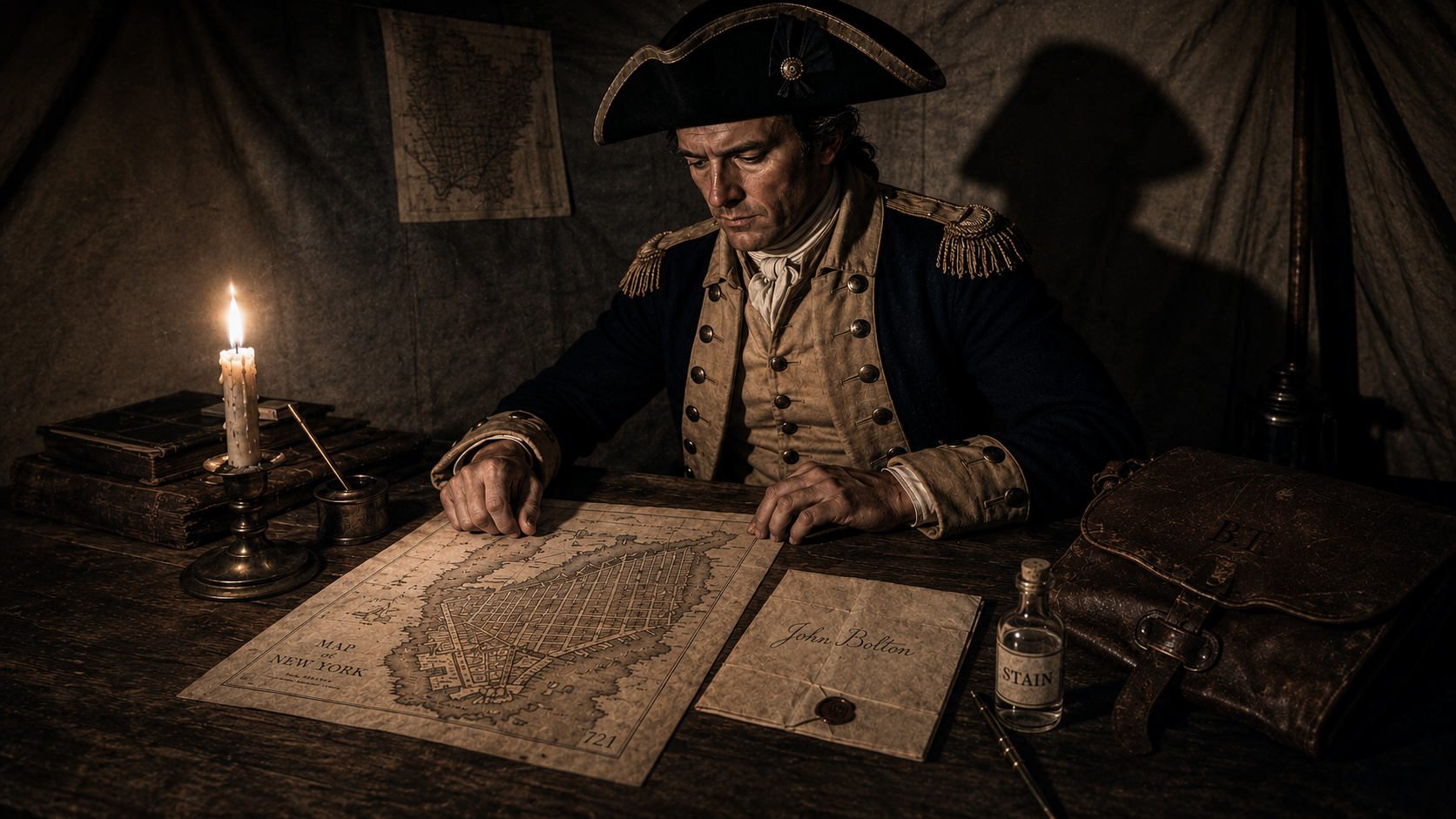
Maps of Long Island spread across his desk. Setauket. Home. Fields he'd worked. Roads he'd walked—the harbor where British ships anchored now.
Somewhere out there, Woodhull was farming. Unaware that Tallmadge was thinking about him.
Brewster was running raids. Did not know the role Tallmadge had planned.
Friends. People who'd known him before the war complicated everything.
He could see the network clearly. Woodhull observing in Setauket and New York. Brewster is carrying messages across the Sound. Couriers moving intelligence through multiple hands. Codes protecting identities. Protocols protecting lives.
It would work. Tallmadge was certain.
But Nathan had been certain, too. Scott's agents had been certain.
The difference was Tallmadge's preparation. It was more thorough, more systematic, built on two years of watching what failed and understanding why. Built on local knowledge, too. Knew Long Island the way Sackett never knew New York. Knew who to trust because he'd grown up with them. Knew who had legitimate reasons to travel. Who resented the occupation. Who had the right temperament for dangerous work?
Advantage and burden both. If Woodhull got hanged, it would not just be losing an agent. Would be losing a friend and asking someone from childhood to risk the rope.
Closed his eyes. Felt the weight settle.
He'd wanted this. Spent two years proving his methods worked better. Argued for architecture over heroics. Now Tallmadge had to prove it and build the network. Trust his protocols to keep people alive.
Maps in front of him. Familiar territory, unfamiliar purpose. Long Island. Where friends lived under occupation, and where he'd build the network that might change the war.
Everything was ready. Codes developed, communications tested, structure designed, and recruitment planned to the smallest detail. Just needed actually to do it. Tallmadge had to look Woodhull in the eye and ask him to risk everything. He had to recruit Brewster into work that could end with a noose.
Not today. Tallmadge would move when the moment was right, when every detail was perfect. When he was certain, he was not sending friends to Nathan's fate.
Soon, though.
He thought of Nathan one last time. His friend would have hated this planning. This obsessive attention to detail. Nathan believed in action, courage, and bold gestures.
Tallmadge could almost see him, animated, gesturing as he made some passionate argument about duty and honor. The way Nathan's eyes had lit up when he talked about the cause. The absolute certainty in his voice that right would prevail because it was right.
That certainty had gotten him killed.
"I am sorry," Tallmadge said to the empty room. His voice sounded hollow in the silence. "I know you would have done this differently. Faster and braver, but bravery without preparation got you killed. I will not let that happen to anyone else."
The candle flame wavered as Tallmadge watched it dance, thinking about how easily the fire could be extinguished. How quickly a life could end.
Outside, the army was settling for another night.
Inside, Tallmadge is studying maps and feeling the weight of what came next.
The network he would build, which did not yet have a name, would operate for the rest of the war without losing a single agent. It would give Washington the intelligence he needed and would prove that systematic preparation plus local knowledge beat bold improvisation.
Tomorrow's work, though.
Tonight, Tallmadge just sat with the weight, knowing everything depended on his choices. Success or failure. Lives saved or lost.
Tomorrow, or next week, or whenever the moment was right, Tallmadge would start recruiting. Approach Woodhull. Bring in, Brewster. Set the Culper Ring in motion.
Not tonight.
Tonight, maps on his desk, waiting. Long Island is waiting. Friends are waiting, unknowing.
Tallmadge, twenty-four years old, carrying the Continental Army's intelligence future, sitting in darkness thinking about responsibility and risk and the privilege of knowing exactly what needed doing.
The careful sword was ready.
Tomorrow, Tallmadge would start wielding it.
Tonight, just feeling the weight of the blade in his hands.
Historical Note:
Benjamin Tallmadge became chief intelligence officer in November 1778. Sackett's civilian network had failed. Clark's Philadelphia operation ended in December 1777 when injury forced his relief. Scott stepped away from intelligence duties.
Two years as liaison taught Tallmadge what worked and what did not. Sackett's failures showed him that recruiting outsiders in unfamiliar territory was fundamentally flawed. Clark's temporary success showed that personal courage could not sustain operations without systematic support. Scott's casualties showed that traditional military approaches produced unacceptable losses.
Key insight: effective intelligence required agents who genuinely belonged in occupied territory. Not covers. Real identities. Local knowledge to distinguish reliable sources from British plants.
The Culper Spy Ring, recruited beginning late 1778, embodied these lessons. Operated the rest of the war successfully and never lost a single agent to British counterintelligence. It was an unprecedented achievement due largely to Tallmadge's methodical approach and deep knowledge of Long Island.
Sometimes the most valuable education comes from watching others fail and understanding why. The careful sword, forged through patient observation and systematic learning, proved mightier than bold gestures. Where history provides facts, this story follows them. Where history is silent, this story imagines what the men who lived it might have said and felt.
End of "The Careful Sword"
Sources
This story is built on historical record, though dialogue and internal thoughts are necessarily imagined. The major events, timeline, and character relationships are drawn from documented history.
Primary Sources:
Tallmadge, Benjamin. Memoir of Colonel Benjamin Tallmadge. Originally published in 1858. Tallmadge's own account of his Revolutionary War service provided invaluable insight into his methodical approach to intelligence work and his relationship with Nathan Hale.
Secondary Sources:
Lesser, Charles H. General Washington's Commando: Benjamin Tallmadge in the Revolutionary War. This detailed military biography provided crucial context for Tallmadge's rise through the ranks and his development as an intelligence officer.
Rose, Alexander. Washington's Spies: The Story of America's First Spy Ring. Rose's comprehensive history of the Culper Ring illuminated the broader intelligence failures that preceded Tallmadge's systematic approach, including the struggles of Nathaniel Sackett, John Clark, and Charles Scott.
Historical Notes:
All dates, military positions, and major events in this story are historically accurate. Nathaniel Sackett received his commission in February 1777 and was relieved in August 1777 after producing minimal results. Major John Clark built intelligence networks in Trenton and New York before his successful Philadelphia operations, which ended in December 1777 due to injury. General Charles Scott stepped away from intelligence duties in November 1778, and Benjamin Tallmadge assumed the role of chief intelligence officer at that time.
The Culper Spy Ring, which Tallmadge began recruiting in late 1778, operated successfully throughout the remainder of the war without losing a single agent to British counterintelligence, a testament to the systematic, methodical approach Tallmadge developed through two years of coordinating and learning from others' methods.
Where history provides facts, this story follows them. Where history is silent, this story imagines what the men who lived it might have said and felt.